
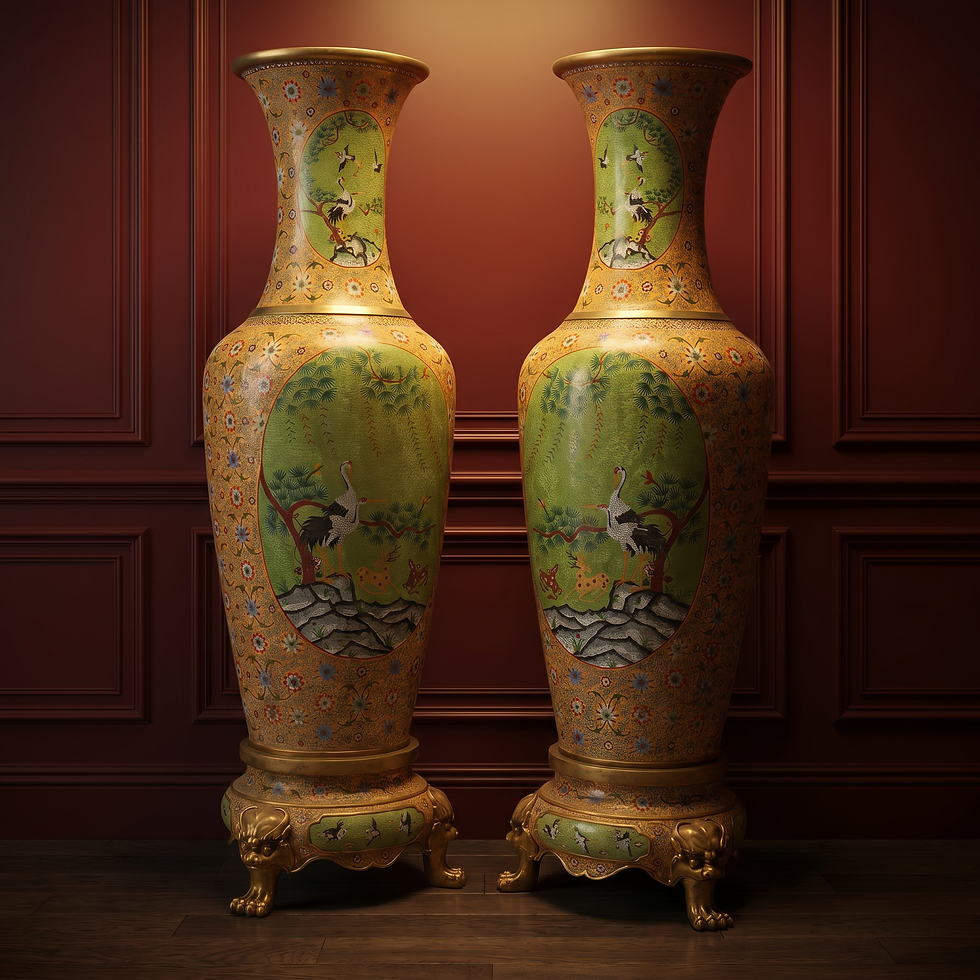
What it's Worth
Value turns on age, origin, and craftsmanship. Decorative 20th-century pieces are modest; fine antique Chinese and Japanese examples with intricate wirework and rich enamels can reach the thousands and well beyond.
Decorative pieces $50–$400; fine antique examples $1,000–$15,000+
Our Sold Results


Recently Sold
And Many More
Overview & History
Cloisonné enamelwork — in which thin metal wires (cloisons) are soldered to a metal body and the cells filled with colored enamel — flourished in China and Japan and was also produced in Europe. Chinese cloisonné dates back centuries and reached its peak during the Ming dynasty (1368–1644) and Qing dynasty (1644–1912), when imperial workshops in Beijing produced pieces of extraordinary quality for the court. Japanese makers refined the art to extraordinary delicacy during the Meiji period (1868–1912), developing wireless (plique-à-jour) cloisonné and achieving a painterly subtlety that differs markedly from the bolder Chinese tradition. Quality is judged by the fineness of the wirework, the richness and control of the enamel colors, the complexity of design, and condition. Antique pieces by master workshops are prized, while later mass-produced wares are more common.
Identifying & Marks
Many pieces are unmarked; some carry Chinese reign marks, Japanese workshop signatures, or 'China'/'Japan' export marks. Judge quality by wire fineness, color depth, and design rather than marks alone. Chinese cloisonné tends to have a heavier bronze body and bolder color palette; Japanese Meiji cloisonné typically has finer wirework, more painterly shading, and a lighter body.
FAQ
How can I tell Chinese cloisonné from Japanese cloisonné?
Chinese cloisonné tends to have a heavier bronze body, bolder color palette, and somewhat less refined wirework. Japanese Meiji-period cloisonné (roughly 1868–1912) typically shows much finer wirework, more painterly shading, and a lighter overall body — Japanese makers refined the technique to an extraordinary level of delicacy, including wireless (plique-à-jour) versions. Both traditions are collectible, but fine Meiji Japanese cloisonné often commands a premium for its technical achievement.
Is my cloisonné piece old or a later decorative piece?
Judge by the fineness of the wire cells, the richness and control of the enamel colors, and the complexity of the design rather than relying on any mark — many pieces are unmarked, and marks that do exist (Chinese reign marks, Japanese workshop signatures, or simple 'China'/'Japan' export marks) aren't always reliable indicators of age on their own. A specialist assessment of the piece in hand is the most reliable way to judge quality and likely date.
What is my cloisonné worth?
Decorative 20th-century pieces typically bring $50–$400. Fine antique Chinese and Japanese examples with intricate wirework and rich, well-preserved enamel colors can reach $1,000–$15,000 or more. Size, complexity of design, and condition (enamel loss or chips significantly reduce value) are the main factors.